
Best AI Contract Review Tools in 2026 (Tested & Compared)
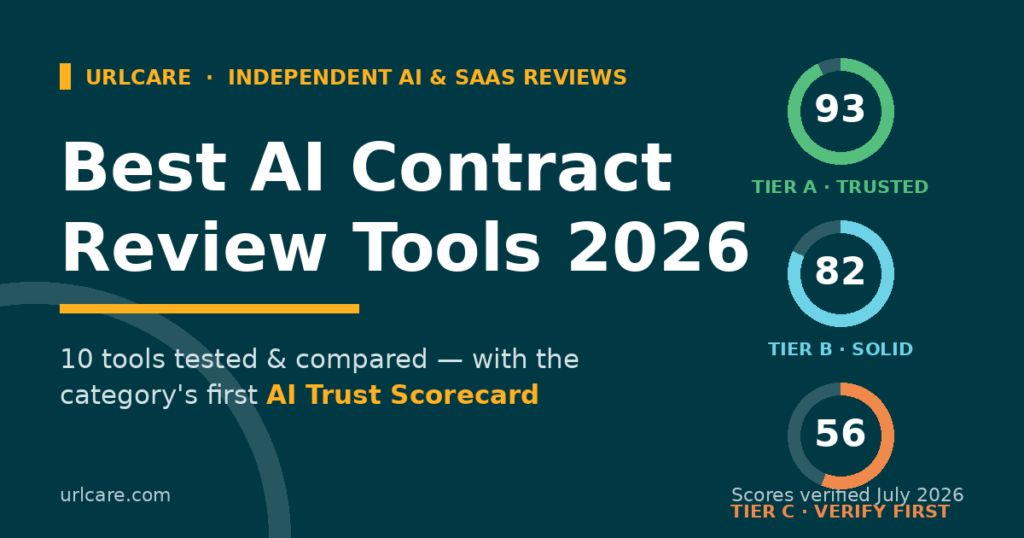
- Published on
- at
- Last updated on August 5, 2026 at
- 6:19 am
Est. reading time: 14 minutes
Some links in this guide are partner links. If you sign up through them, Urlcare may earn a commission at no extra cost to you. This never affects our rankings — and it never affects Trust Scores, which are computed only from published vendor documentation using the methodology disclosed below.
Choosing an AI contract review tool is one of the highest-leverage decisions a legal team makes. The right one turns a 45-minute first-pass review into a five-minute check; the wrong one becomes an expensive Word add-in nobody opens — or worse, a quiet data-governance liability sitting between your contracts and someone else's language model. Over the past several weeks I evaluated the leading contract review AI platforms: the self-serve tools hands-on , and the enterprise platforms through vendor demos, published documentation, and verified user feedback.
This guide ranks the ten best AI contract review tools in 2026, with honest pros and cons, current pricing, and clear guidance on who each one is for. And because the first question every buyer now asks is "what happens to my contracts?", every tool here also gets an AI Trust Score — a standardized 0–100 rating of its data-safety posture, scored from published security documentation. To my knowledge, no other independent comparison in this category publishes one.
The short version: for most transactional teams, Spellbook is the best overall pick — the broadest AI suite for commercial contracts, market-data benchmarking no rival matches, and a self-serve trial. Gavel Exec is the value pick with transparent pricing at $145/user/month, and Ivo is the enterprise choice for playbook enforcement at scale. On data safety, LegalOn (93/100) and LEGALFLY (88/100) top our Trust Scorecard.
Best AI Contract Review Tools: At a Glance
| # | Tool | Best for | Starting price* | Trust Score† |
|---|---|---|---|---|
| 1 | Spellbook | Best overall for transactional teams | Custom (~$179+/user/mo mid-tier) | 82 · B |
| 2 | Ivo | Best enterprise playbook enforcement | $6,000/user/yr all-inclusive | 83 · B |
| 3 | LegalOn | Best pre-built playbooks + top trust score | ~$3,500/user/yr | 93 · A |
| 4 | Gavel Exec | Best value & transparent pricing | $145/user/mo (annual) | 73 · B |
| 5 | goHeather | Best budget pick for small firms | Self-serve, low-cost | 15 · Provisional‡ |
| 6 | LEGALFLY | Best for EU & privacy-first teams | Custom quote | 88 · A |
| 7 | Luminance | Best for M&A due diligence | Custom (~$50K/yr typical) | 56 · C |
| 8 | Ironclad | Best CLM with AI review built in | Custom (from ~$50K/yr) | 73 · B |
| 9 | Harvey | Best enterprise legal AI platform | $30K–$300K+/yr (25+ seats) | 76 · B |
| 10 | CoCounsel | Best research + review combo | $220–$500/user/mo | 80 · B |
*Billed annually where applicable. Vendors adjust pricing frequently — confirm current rates on each official pricing page before purchasing. †AI Trust Score: 0–100, computed from each vendor's published security documentation as of July 16, 2026 — full methodology below. ‡Provisional: reflects the absence of locatable public security documentation, not audited practice; vendor invited to verify.
How We Evaluated These Tools
Rankings are based on five criteria that matter most to legal teams: review accuracy and redline quality (does the first pass actually save lawyer time, or create cleanup work), workflow integration (Microsoft Word–native beats browser-hopping for most legal work), value for money (features per dollar at the tiers teams actually buy), playbook depth (pre-built standards, custom rules, and fallback positions), and data safety — scored separately and transparently as the AI Trust Score, because for confidential legal work this is non-negotiable.
A note on testing honesty, because most "reviews" in this category skip it: only three of these ten tools offer genuine self-serve access. Spellbook, Gavel Exec, and goHeather. The other seven gate access behind sales demos; those I evaluated through vendor demonstrations, current trust-center and pricing documentation, and verified user reviews. Where a claim couldn't be independently verified, I say so — and every estimated figure in the Trust Scorecard is marked.
1
★ Editor's Choice — Best Overall
Spellbook — Best Overall for Transactional Teams
Best for: commercial lawyers and in-house teams who live in Microsoft Word and review contracts at volume
Spellbook is the tool I recommend to most transactional teams, and the reason is breadth. It drafts, reviews, redlines, and benchmarks inside Word, and its Compare-to-Market feature — which checks clauses like term and termination against thousands of recent agreements — gives you a statistical basis for negotiation positions that no playbook-only rival offers. Over 4,000 legal teams use it, from solo practitioners to companies like Dropbox and Crocs.
The honest trade-offs: some reviewers note its output can need cleanup on complex documents, and enterprise pricing rose sharply in late 2025 — teams renewing in 2026 should get a fresh quote rather than trusting older benchmarks.Pricing: custom quotes only. Industry estimates put entry plans around $20–$40/user/mo, mid-tier near $179/user/mo, and enterprise around $350/user/mo with a 6-month minimum. Free self-serve trial available.
82AI Trust Score
Tier B · Solid▾
Strong verified posture; ISO 27001 is absent from its public documentation.
Data training Verified25/25
No training on customer documents — published guarantee.
Retention & deletion Verified15/15
Zero-retention agreements naming OpenAI and Anthropic.
Data residency Verified6/10
AWS Canada + US disclosed; no customer region choice.
Certifications Verified14/20
SOC 2 Type II, HIPAA, GDPR/CCPA, EU AI Act; no ISO 27001.
Sub-processor transparency Verified12/15
LLM providers named; full public sub-processor list not found.
Track record Estimated10/15
No disclosed incidents; pen-test program not published.
✓ Last verified July 16, 2026 · scored from published documentation only · methodology
Pros
- Broadest AI suite for contracts: draft, review, redline, benchmark
- Compare-to-Market negotiation data is unique in this list
- Self-serve trial — no sales call needed to evaluate
- Strong, documented security posture with named LLM providers
Cons
- No public pricing; enterprise cost rose significantly in late 2025
- Output on complex documents can need cleanup
- Playbook depth trails specialists like Ivo and LegalOn
Spellbook vs Ivo: Ivo enforces your standards more rigidly and consistently; Spellbook is more flexible and adds market data — pick Ivo for high-volume uniformity, Spellbook for negotiation leverage. Spellbook vs Gavel Exec: Gavel is roughly half the price with surgical redlines; Spellbook wins on breadth and benchmarking.
Bottom line: if you want the most capable all-round contract AI your team can actually trial today, Spellbook is the pick — just negotiate the price knowingly.
Try Spellbook Free →2
Ivo — Best for Enterprise Playbook Enforcement
Best for: in-house legal departments that review high volumes of repeatable contracts against established standards
Ivo does one thing with conviction: it applies your negotiation playbooks to incoming contracts, consistently, inside Word — plus an AI-native repository (Ivo Intelligence) that auto-tags your portfolio without manual metadata work. It raised a $55M Series B in early 2026 and counts Uber, Shopify, Atlassian, Reddit, and Canva as customers; the company claims its redlines win 80–85% of competitive evaluations, though that figure is Ivo's own and I couldn't verify it independently.
Pricing: $6,000/user/yr, all-inclusive — playbook creation, onboarding, and ongoing support are bundled. No public self-serve tier.
83AI Trust Score
Tier B · Solid▾
Certified and committed; residency detail is gated at trust.ivo.ai.
Data training Verified25/25
Does not train AI models on customer data.
Retention & deletion Verified15/15
Zero-retention agreement with Azure OpenAI.
Data residency Estimated3/10
Not published; documentation on request via trust center.
Certifications Verified18/20
SOC 2 Type II, ISO 27001, GDPR/CCPA.
Sub-processor transparency Verified12/15
Azure OpenAI named; full list gated.
Track record Estimated10/15
No disclosed incidents; testing program not published.
✓ Last verified July 16, 2026 · scored from published documentation only · methodology
Pros
- Best-in-class playbook consistency for high-volume review
- Repository intelligence with zero manual tagging
- Flat all-inclusive pricing — no surprise add-ons
Cons
- Rigid by design — weaker fit for bespoke, one-off negotiations
- No trial; evaluation requires a sales process
- Marquee accuracy claims are vendor-reported
3
LegalOn — Best Pre-Built Playbooks (and Our Top Trust Score)
Best for: corporate legal departments that want attorney-drafted standards working on day one
LegalOn ships 50+ pre-built, attorney-drafted playbooks, which means useful review output before you've configured anything — the fastest time-to-value in this group for teams handling recurring NDAs, MSAs, and sales agreements. It's used by 7,500+ organizations, supports multilingual and cross-jurisdiction review, and pairs curated legal standards with generative AI drafting.
It also publishes the most complete security documentation of any tool I evaluated — which is exactly why it tops the Trust Scorecard. Its Azure OpenAI arrangement commits that no customer data is used to train models and none is stored for any period, even for abuse monitoring.
Pricing: per-seat, per-module. Individual licenses from ~$3,500/user/yr; full-featured enterprise around $8,000/user/yr. Quote required.
93AI Trust Score
Tier A · Trusted▾
The most complete published data-safety documentation in this comparison.
Data training Verified25/25
Azure OpenAI: no training, retraining, or model improvement.
Retention & deletion Verified15/15
Zero storage on the LLM leg — even abuse monitoring.
Data residency Verified6/10
US hosting on AWS and GCP, disclosed.
Certifications Verified20/20
SOC 2 Type II, ISO 27001:2022, ISO 27017, GDPR/CCPA.
Sub-processor transparency Verified12/15
AWS, GCP, Azure OpenAI named; full list not public.
Track record Verified15/15
Annual penetration testing publicly disclosed; no incidents.
✓ Last verified July 16, 2026 · scored from published documentation only · methodology
Pros
- 50+ attorney-built playbooks — fastest time-to-value
- The strongest published data-safety posture in this comparison
- Multilingual, cross-jurisdiction review
Cons
- Per-seat, per-module pricing climbs quickly at full feature depth
- More structured than flexible — customization trails Spellbook
- No self-serve trial
4
Gavel Exec — Best Value with Transparent Pricing
Best for: small and mid-size firms and lean in-house teams that want practice-ready redlines without enterprise pricing
Gavel Exec is the only serious contract AI here with published per-seat pricing, and at roughly half of Spellbook's mid-tier it delivers a precedent-based redline engine, pre-built playbooks, and market benchmarking inside Word (and, since April 2026, a web platform). Its AI is opt-in by design, and documents aren't stored when you use it — a genuinely buyer-friendly architecture.
One finding from the trust verification worth knowing: Gavel's security page cites AWS's SOC and ISO certifications — those are the data center's audits, not Gavel's own. Gavel references its own SOC 2 compliance, but the report type isn't verifiable from public documentation. That distinction is exactly what our scorecard exists to catch.
Pricing: $145/user/mo billed annually ($1,740/yr), or $160/user/mo monthly. 25 free queries to start — effectively a self-serve trial.
73AI Trust Score
Tier B · Solid▾
Buyer-friendly architecture; its own audit documentation is the gap.
Data training Verified25/25
No training on customer data, prompts, or documents.
Retention & deletion Verified15/15
No document storage for AI; zero-retention with OpenAI et al.
Data residency Estimated3/10
AWS hosting; no region commitment published.
Certifications Estimated8/20
Own SOC 2 claimed, type unverified; AWS infra certs are not Gavel's.
Sub-processor transparency Verified12/15
OpenAI and other AI providers named.
Track record Estimated10/15
No disclosed incidents; no published testing program.
✓ Last verified July 16, 2026 · scored from published documentation only · methodology
Pros
- Transparent pricing — rare in this category
- Practice-ready redlines with real market intelligence
- AI is optional and stores nothing — clean privacy architecture
Cons
- Smaller company and ecosystem than the majors
- Own certification documentation is thinner than top-tier rivals
- Web platform is newer and still maturing
5
goHeather — Best Budget Pick for Small Firms
Best for: small firms and back-office teams reviewing the same contract types repeatedly on a tight budget
goHeather's pitch is democratization: enterprise-style contract review — DIY playbooks, a full Word add-in, red-light/green-light approval workflows a junior clerk can run — with instant self-serve signup and no sales process. For a small firm that reviews the same NDA fifty times a year, that's a compelling, low-friction proposition.
The serious caveat: as of July 16, 2026, I could not locate any published security documentation — no certifications, no data-training commitment, no sub-processor disclosure. Its provisional Trust Score reflects that absence of disclosure, not audited practice, and goHeather has been invited to supply documentation for re-scoring. Until then, I wouldn't route confidential client contracts through it.
Pricing: self-serve and SMB-oriented; full tier pricing not consistently published — confirm in-app before committing.
15AI Trust Score
Insufficient disclosure▾
Reflects absence of public documentation, not audited practice — vendor invited to verify.
Data training Not located0/25
No data-training policy located.
Retention & deletion Estimated5/15
Generic privacy-policy language only.
Data residency Not located0/10
Not disclosed.
Certifications Not located0/20
No certifications located.
Sub-processor transparency Not located0/15
No sub-processor disclosure located.
Track record Estimated10/15
No disclosed incidents; no published program.
✓ Last verified July 16, 2026 · scored from published documentation only · methodology
Pros
- Instant self-serve start — no sales gauntlet
- Approval workflows non-lawyers can safely run
- Genuinely affordable entry point
Cons
- No published security certifications or data-training policy found
- Lighter analysis depth than the specialists above
- Small ecosystem
6
LEGALFLY — Best for EU Teams & Privacy-First Buyers
Best for: European in-house teams and any organization where data governance leads the buying decision
LEGALFLY's differentiator is architectural: it anonymizes contract data before AI processing, and it's the only vendor in this comparison offering on-premise deployment — meaning your contracts can stay entirely inside your infrastructure. Built for in-house teams, it applies playbooks, flags deviations, and claims 50–80% review-time reductions (vendor-reported). For GDPR-first organizations, it's the most defensible choice on this list.
Pricing: custom quote; positioned for in-house legal teams.
88AI Trust Score
Tier A · Trusted▾
Privacy-first by architecture: anonymization before AI, on-premise available.
Data training Verified25/25
Customer data never used to train models.
Retention & deletion Verified10/15
Anonymization pre-processing; retention terms not itemized.
Data residency Verified10/10
EU-based, with an on-premise deployment option.
Certifications Verified18/20
SOC 2 Type II, ISO 27001, GDPR.
Sub-processor transparency Estimated10/15
Anonymization mitigates exposure; named list not located.
Track record Verified15/15
Independent audits and penetration testing disclosed.
✓ Last verified July 16, 2026 · scored from published documentation only · methodology
Pros
- Anonymization-before-AI is unique in this comparison
- On-premise deployment option — the ultimate residency control
- Strong verified certifications with disclosed pen-testing
Cons
- Quote-based pricing; no self-serve evaluation
- EU-first focus — thinner US brand presence
- Efficiency claims are vendor-reported
7
Luminance — Best for M&A Due Diligence
Best for: deal teams and firms running large-document-set diligence, deal rooms, and portfolio anomaly detection
Luminance is the most capable standalone review engine here for one job: finding anomalies across thousands of documents at once. Each customer gets a dedicated single-tenant AWS instance — complete isolation, no co-mingling — which is a strong architecture for deal confidentiality. It's less suited to day-to-day single-contract redlining than the Word-native tools above, and its enterprise pricing reflects its enterprise focus.
Its Trust Score is worth explaining: Luminance publicly documents ISO 27001:2022 and its isolation architecture, but its public pages don't state a customer-data training policy, retention terms, or a sub-processor list. The C grade measures that disclosure gap, not its (likely stronger) gated enterprise documentation — a distinction its sales team can resolve in one email.
Pricing: custom; typically around $50K/yr for enterprise deployments.
56AI Trust Score
Tier C · Verify first▾
Strong isolation architecture; public disclosure lags its enterprise reality.
Data training Estimated15/25
Single-tenant isolation verified; training policy unstated.
Retention & deletion Estimated5/15
Retention terms not publicly stated.
Data residency Verified8/10
Dedicated AWS instances; geographic flexibility.
Certifications Verified10/20
ISO 27001:2022 verified; SOC 2 not located.
Sub-processor transparency Verified8/15
AWS named; LLM providers not disclosed.
Track record Estimated10/15
No disclosed incidents; program not published.
✓ Last verified July 16, 2026 · scored from published documentation only · methodology
Pros
- Unmatched pattern/anomaly detection across huge document sets
- Single-tenant isolation per customer
- Geographic hosting flexibility on AWS
Cons
- Public data-safety disclosure lags its enterprise reality
- Overkill and overpriced for routine contract review
- Custom pricing only
8
Ironclad — Best CLM with AI Review Built In
Best for: legal ops teams that need the full contract lifecycle — workflow, approvals, repository — with AI review as one layer
Ironclad is a contract lifecycle management platform first, with an AI layer that flags deviations, extracts terms, and catches the clause on page 37 that quietly changed from 30 days to 60. Its drag-and-drop workflow builder is the best in CLM, and G2 reviewers consistently praise how it keeps contracts moving with legal oversight intact. If your problem is process — intake, approvals, post-signature obligations — Ironclad solves it; if your problem is purely first-pass review, the Word-native tools above do that job for a fraction of the cost.
Pricing: custom; annual contracts typically start around $50K for mid-market deployments and scale with workflows and AI features.
73AI Trust Score
Tier B · Solid▾
Mature enterprise program; the specifics live behind a gated trust center.
Data training Estimated25/25
No-training commitment (credible secondary sources).
Retention & deletion Estimated12/15
Zero-retention policies reported.
Data residency Estimated3/10
On request via enterprise trust center.
Certifications Estimated18/20
ISO 27001 and SOC 2 via credible secondary sources.
Sub-processor transparency Estimated5/15
Not publicly listed.
Track record Estimated10/15
No disclosed incidents.
✓ Last verified July 16, 2026 · scored from published documentation only · methodology
Pros
- Best-in-class workflow builder; genuinely liked by users
- Full lifecycle: intake to post-signature obligations
- Mature enterprise security program
Cons
- Heavy and expensive if you only need review
- Reporting/analytics underdeveloped relative to the platform
- Slower than lean review-first rivals
9
Harvey — Best Enterprise Legal AI Platform
Best for: Am Law-scale firms and large legal departments buying a firm-wide AI platform, not a contract tool
Harvey is the platform big law standardizes on: research, document analysis, drafting, and contract work under one roof, with Vault handling up to 100,000 documents per matter and ethical walls built in as core features. Contract review is one capability among many — which is exactly why it's the wrong buy if contract review is your only problem. There's no trial, no self-serve, and seat minimums put entry around $30K/yr at the floor and well past $300K at scale.
Pricing: enterprise only — typically 25–50+ seat minimums, $30K–$300K+/yr before add-ons. No self-serve, no SMB tier.
76AI Trust Score
Tier B · Solid▾
Enterprise-grade by reputation; nearly everything requires the sales process to verify.
Data training Estimated25/25
No training on customer data (secondary sources).
Retention & deletion Estimated10/15
Enterprise DPAs; terms gated.
Data residency Estimated3/10
Azure-hosted; regions on request.
Certifications Estimated20/20
SOC 2 Type II, ISO 27001, HIPAA, GDPR (secondary sources).
Sub-processor transparency Estimated8/15
Azure/OpenAI relationship known; formal list gated.
Track record Estimated10/15
No disclosed incidents; ethical walls built in.
✓ Last verified July 16, 2026 · scored from published documentation only · methodology
Pros
- The broadest legal AI platform in this comparison
- Ethical walls and matter segregation as first-class features
- Custom model work for large deployments
Cons
- Inaccessible to small firms — no trial, steep minimums
- Paying for a platform when you may only need review
- Public security disclosure thinner than its enterprise reality
10
CoCounsel (Thomson Reuters) — Best Research + Review Combo
Best for: firms that want contract analysis and authoritative legal research in one subscription, without Harvey's seat minimums
CoCounsel pairs document review and drafting with the Westlaw research corpus — a combination none of the contract-first tools can offer — at per-user pricing with no seat minimums, making it the accessible route to enterprise-grade legal AI. It holds SOC 2 Type II, ISO 27001, and ISO 42001 (the new AI-management standard), with a zero-retention API architecture for third-party LLMs and published data-residency controls.
One nuance the Trust Scorecard surfaced: Thomson Reuters commits that your data is never used to train third-party models — but its own security documentation states it "may use your interaction with the product, through queries and uploaded documents, to improve the product." That's a materially different promise than LegalOn's or Gavel's, and buyers should confirm opt-out terms in their DPA before uploading sensitive matter documents.
Pricing: $220–$500/user/mo depending on configuration; no seat minimums.
80AI Trust Score
Tier B · Solid▾
Strong certifications with one asterisk: internal product-improvement data use.
Data training Verified15/25
No third-party training; internal improvement use disclosed — check your DPA.
Retention & deletion Verified15/15
Zero-retention API calls to third-party LLMs.
Data residency Verified10/10
US processing; residency controls published.
Certifications Verified20/20
SOC 2 Type II, ISO 27001, ISO 42001.
Sub-processor transparency Verified8/15
Zero-retention LLM APIs; full list enterprise-gated.
Track record Verified12/15
24/7 monitoring; no disclosed CoCounsel incidents.
✓ Last verified July 16, 2026 · scored from published documentation only · methodology
Pros
- Research + review in one flow, backed by Westlaw
- No seat minimums — accessible enterprise-grade AI
- Strong certifications including ISO 42001
Cons
- Product-improvement data use needs a DPA conversation
- Value is coupled to the Thomson Reuters ecosystem — lock-in risk
- Costlier per user than Word-native specialists
The AI Trust Scorecard: How Safe Is Your Contract Data?
Every legal buyer in 2026 asks the same three questions: does this tool train on my contracts, where does my data live, and who else touches it. Vendors answer in marketing language; nobody had built a standardized, comparable score — so we did. Each tool below is scored 0–100 across six weighted factors, using only publicly verifiable documentation (trust centers, security pages, DPAs) as of July 16, 2026.
The scoring rubric
| Factor | Weight | How it's scored |
|---|---|---|
| Training on customer data | 25 | No training by default = 25 · third-party-only commitment or opt-out = 15 · opt-in, default-on = 5 · undisclosed = 0 |
| Retention & deletion | 15 | Named zero-retention LLM processing = 15 · defined retention + deletion controls = 10 · vague = 5 · undisclosed = 0 |
| Data residency | 10 | Region choice or on-premise = 10 · single disclosed region = 6 · gated/on-request = 3 · undisclosed = 0 |
| Certifications | 20 | SOC 2 Type II = 8 · ISO 27001 = 6 · GDPR/DPA published = 4 · extras (ISO 27017/42001, HIPAA, etc.) = 2 |
| Sub-processor transparency | 15 | Public list naming LLM providers = 15 · LLM providers named, full list gated = 8–12 · none = 0 |
| Security track record | 15 | No disclosed incidents + published pen-testing = 15 · no disclosed incidents, no published program = 10 · disclosed incident, remediated = 7 · opaque = 0–5 |
Tiers: 85–100 = A · Trusted 70–84 = B · Solid 50–69 = C · Verify first below 50 = High caution. Training-on-data carries the heaviest weight because it is the number-one buyer concern in this category; certifications are capped at 20 so a cert-heavy but opaque vendor cannot max out. Transparency itself is scored — "undisclosed" costs points by design.
Abbreviations used in this scorecard
SOC 2 Type II — an independent AICPA audit verifying that security controls operate effectively over time (Type I only checks a single date). ISO 27001 — the international information-security management standard; ISO 27017 adds cloud-specific controls; ISO 42001 covers AI management systems. GDPR / CCPA — the EU and California privacy regulations. DPA — Data Processing Agreement, the contract governing how a vendor may handle your data. ZDR — zero data retention: the AI provider stores nothing from your API calls. LLM — large language model (the OpenAI, Anthropic, or Azure OpenAI models these tools run on). Sub-processor — any third party a vendor uses to process your data. CLM — contract lifecycle management.
Key terms in 20 seconds
- SOC 2 Type II — an independent audit confirming security controls operated effectively over months, not just on paper.
- ISO 27001 — the international certification for an information-security management system; ISO 27017 adds cloud-specific controls, ISO 42001 covers AI management.
- DPA — Data Processing Agreement: the contract that legally governs how a vendor handles your data. Get commitments here, not in marketing pages.
- Zero-retention (ZDR) — the LLM provider keeps nothing after processing your document; the strongest form of the no-training promise.
- Sub-processor — any third party (cloud host, LLM provider) that touches your data downstream of the vendor.
The results
| Tool | Trains on your data? | Zero-retention LLM deal | Key certifications | Score |
|---|---|---|---|---|
| LegalOn | No ✓ | Yes — Azure OpenAI, named, incl. no abuse-monitoring storage ✓ | SOC 2 Type II · ISO 27001 · ISO 27017 · GDPR/CCPA ✓ | 93 · A |
| LEGALFLY | No ✓ | Anonymization before AI + on-premise option ✓ | SOC 2 Type II · ISO 27001 · GDPR ✓ | 88 · A |
| Ivo | No ✓ | Yes — Azure OpenAI ✓ | SOC 2 Type II · ISO 27001 · GDPR/CCPA ✓ | 83 · B |
| Spellbook | No ✓ | Yes — OpenAI + Anthropic, named ✓ | SOC 2 Type II · HIPAA · GDPR/CCPA · EU AI Act ✓ | 82 · B |
| CoCounsel | No third-party training ✓ — internal product-improvement use disclosed; verify DPA opt-out | Yes — zero-retention API architecture ✓ | SOC 2 Type II · ISO 27001 · ISO 42001 ✓ | 80 · B |
| Harvey | No ~ | Enterprise DPAs; specifics gated ~ | SOC 2 Type II · ISO 27001 · HIPAA · GDPR ~ | 76 · B |
| Ironclad | No ~ | Zero-retention policies reported ~ | ISO 27001 · SOC 2 ~ | 73 · B |
| Gavel Exec | No ✓ | Yes — OpenAI and other providers ✓ · no document storage for AI ✓ | Own SOC 2 claimed, type unverified; AWS infra certs are the data center's, not Gavel's | 73 · B |
| Luminance | Not publicly stated ~ (single-tenant isolation verified ✓) | Not publicly stated ~ | ISO 27001:2022 ✓ | 56 · C |
| goHeather | Not located ~ | Not located ~ | None located ~ | 15 · Provisional |
✓ = verified against the vendor's own published trust documentation. ~ = estimated from credible secondary sources or reflects an absence of public disclosure, pending vendor verification. Scores measure publicly verifiable posture — a low score for a gated enterprise vendor (Luminance) or an undocumented SMB tool (goHeather) reflects disclosure, not necessarily practice.
Independence firewall: sponsored placements and partner links never affect Trust Scores. Scores are computed mechanically from the rubric above and re-verified quarterly. Vendors: if your documentation has changed or we've missed something public, email 🔲 admin@urlcare.com with a link and we'll re-score within 7 days — corrections are logged at the foot of this page.
Contract Review AI vs. CLM vs. Legal Research Tools: What's the Difference?
These three categories get lumped together constantly — and buying the wrong one is the most common (and expensive) mistake in legal tech. Contract review AI analyzes documents that already exist: it reads an incoming agreement, flags risks against your standards, and suggests redlines — that's every tool ranked above. Contract lifecycle management (CLM) manages the process around contracts: intake, approval workflows, e-signature, storage, renewals, and post-signature obligations; Ironclad is the CLM in this list, with AI review as one layer. Legal research tools answer questions of law — case law, statutes, citations — rather than analyzing your documents; CoCounsel straddles this line by bundling Westlaw research with document review.
| Contract Review AI | CLM | Legal Research | |
|---|---|---|---|
| Core job | Analyze and redline existing contracts | Run the contract process end-to-end | Answer questions of law with citations |
| Typical user | Lawyer reviewing third-party paper | Legal ops managing volume and workflow | Lawyer researching a position |
| Examples here | Spellbook, Ivo, LegalOn, Gavel Exec | Ironclad | CoCounsel (with Westlaw) |
| Buy it when | First-pass review eats lawyer hours | Contracts get lost between teams | Research and drafting share one workflow |
Many teams eventually run one of each — and if your bottleneck is firm-wide process rather than document analysis, start with our guide to the best legal workflow software instead.
How to Choose the Right AI Contract Review Tool
Before you commit, work through five quick questions. What's your contract volume and type? High-volume repeatable paper (NDAs, MSAs) favors playbook engines like Ivo and LegalOn; varied, negotiated deals favor Spellbook's flexibility. Where does your team work? If the answer is Microsoft Word — and for most lawyers it is — stay Word-native; browser-only tools quietly die of non-adoption. What's your real budget? Gavel Exec ($145/user/mo) and goHeather anchor the affordable end; the enterprise platforms start around $30–50K/yr. What's your data-safety bar? If contracts are privileged or regulated, treat a Trust Score below 70 as a "verify first" flag and get the vendor's DPA in writing — LegalOn and LEGALFLY clear the bar most convincingly today. Do you need review, or the whole lifecycle? If contracts get lost between sales, legal, and finance, your problem is workflow — that's CLM territory, not review.
My practical advice: shortlist two, run them on the same real contract for a week — Spellbook and Gavel Exec both let you start today without a sales call — and see which one your team actually opens on day five. The best contract AI is the one that survives contact with a Tuesday afternoon.
Frequently Asked Questions
What is AI contract review software?
AI contract review software reads, analyzes, and flags issues in legal agreements automatically — extracting key terms, comparing clauses against your playbook or market standards, scoring risk, and suggesting redlines. It handles the first-pass analysis in minutes so lawyers spend their time on judgment and negotiation rather than repetitive checks.
Do AI contract review tools train on my data?
The reputable ones don't — but the guarantees vary more than vendors admit. LegalOn, LEGALFLY, Ivo, Spellbook, and Gavel Exec all publish commitments that customer data is never used to train AI models, several with named zero-retention agreements covering OpenAI, Anthropic, or Azure OpenAI. Always confirm the commitment names the actual LLM providers and appears in your DPA — and check our Trust Scorecard above for what each vendor actually publishes.
How much does AI contract review software cost?
Self-serve tools start around $145–$179 per user per month (Gavel Exec, Spellbook mid-tier). Dedicated in-house platforms run roughly $3,500–$8,000 per user per year (LegalOn, Ivo). Enterprise platforms like Harvey, Luminance, and Ironclad are quote-based, typically $30,000–$300,000+ per year. Most vendors bill annually and adjust pricing often — confirm current rates before buying.
What is the best AI contract review tool for a small law firm?
Gavel Exec is the strongest small-firm pick — transparent pricing at $145/user/month, practice-ready redlines, and a privacy-friendly architecture. Spellbook is worth the premium if you want market-data benchmarking, and goHeather is the budget entry point for repetitive contract types — though verify its security posture before routing confidential client documents through it.
What's the difference between contract review AI and contract lifecycle management (CLM)?
Contract review AI analyzes documents that already exist — flagging risks and suggesting redlines. CLM manages the entire contract process: intake, approvals, signature, storage, and renewals. Review tools make lawyers faster; CLM makes the process visible. Many teams use one of each, and Ironclad is the main platform here that does both.
Can AI replace lawyers for contract review?
No. AI contract review handles the first pass — extraction, deviation-flagging, and draft redlines — but legal judgment, negotiation strategy, and final sign-off remain a lawyer's job, and every vendor in this guide says the same. Treat these tools as accelerators for legal professionals, not substitutes for legal advice.
The Verdict
After evaluating all ten platforms, Spellbook is our top pick for AI contract review in 2026 — the broadest capable suite for transactional work, unique market benchmarking, and one of only three tools here you can trial today without talking to sales. Choose Gavel Exec if value and transparent pricing matter most, Ivo for enterprise playbook enforcement, Luminance for M&A diligence, and Ironclad when your real problem is the contract process, not the review.
And if data safety leads your decision — as it now does for most in-house buyers — LegalOn (93/100) and LEGALFLY (88/100) top our Trust Scorecard with the most complete published security postures in the category.
Whichever you pick, run it on a real contract for a week before committing. Start with Spellbook's free trial here →
Pricing verified July 2026 from vendor pages and multiple independent sources; vendors adjust pricing periodically — confirm current rates on each official pricing page before purchasing. AI Trust Scores computed July 16, 2026 from published vendor documentation using the disclosed rubric; ✓ items verified against vendor trust pages, ~ items estimated from secondary sources pending vendor verification. Urlcare reviews are independent; partner links may earn us a commission at no cost to you, and sponsorships never affect rankings or Trust Scores.